Home › Hydrocyclones
HydrocyclonesSizing, supply and spare parts for hydrocycloning
We size your hydrocyclone circuit and supply hydrocyclones, original and alternative spare parts and custom-made parts for mining and aggregates.
01
What a hydrocyclone is and what it is for
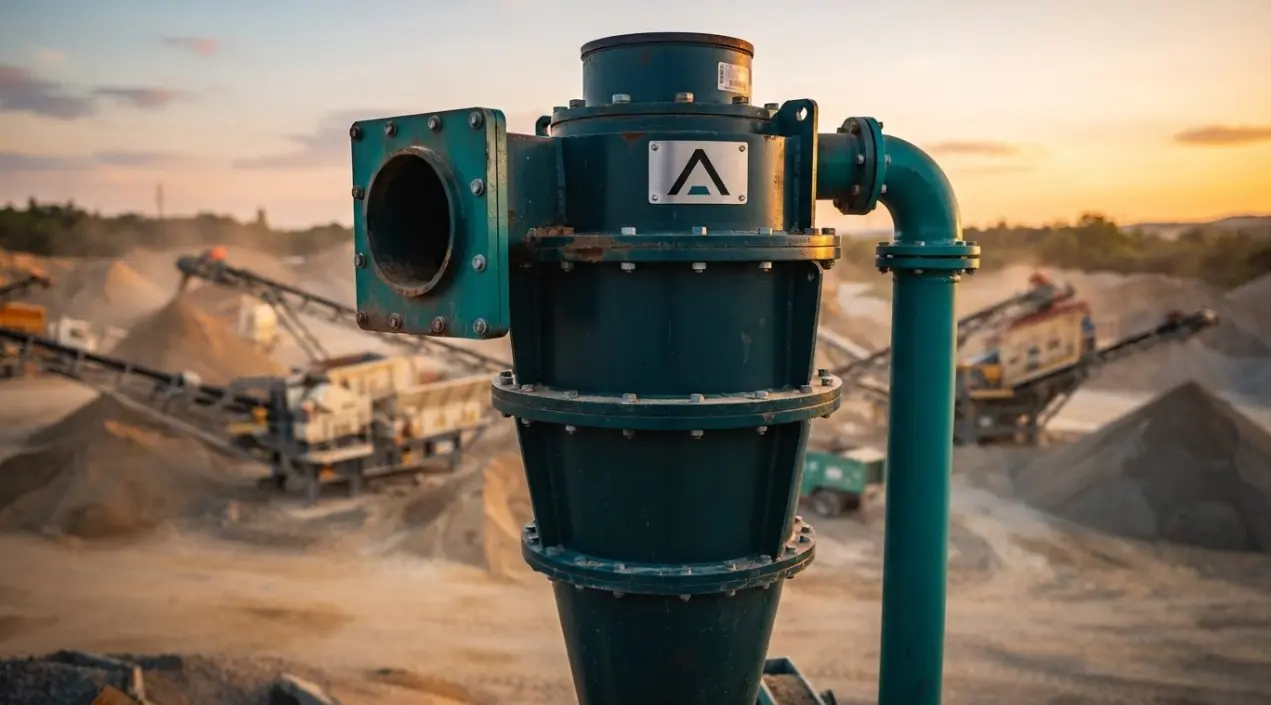
A hydrocyclone separates solids from a liquid slurry using centrifugal force, with no moving parts. In aggregates and mining plants it is used to classify by size, deslime and thicken.
The cut size is the particle size that has a 50% probability of going to the overflow and 50% of going to the underflow. It is set by the feed pressure, the cyclone geometry (inlet, vortex finder and apex) and the solids concentration. That is why a worn apex or vortex finder changes the cut.
- 01The slurry enters under pressure through the tangential inlet and spins inside the body.
- 02The coarse particles move towards the wall, go down the cone and leave through the apex: this is the underflow.
- 03The fines, with most of the water, rise through the centre and leave through the vortex finder: this is the overflow.
Hydrocyclone, cross-section
Tap a number to see each part: feed nozzle and tangential inlet, vortex finder, cylindrical and conical body, apex and the two outlets. Move the control to see how the flow changes with the feed rate. The apex is the part that wears most: we supply alternative spare parts and custom-made parts.
Hydrocyclone, cross-section
Tap a number to see each part.
02
What changes when you touch each setting
Raise or lower a setting and see how the cut and the flow split change. These are variations on a published cyclone; we calculate your circuit with your own data.
Settings
Effect on the cut and the split
Partition curve (% of each size going to the underflow)
03
What we do with hydrocycloning
Hydrocyclone calculation
We define the process flowsheet and select the diameter, number of cyclones, apex and vortex finder according to flow rate, slurry density and target cut.
Equipment supply
We supply hydrocyclones and the equipment of your classification circuit, defined with the process calculation.
Spare parts and components
Any component related to hydrocycloning: original and alternative spare parts and custom-made parts from a drawing or sample.
04
Hydrocyclone components
| Component | What it does |
|---|---|
| Feed nozzle | Receives the slurry from the feed pipe. |
| Tangential inlet | Brings the slurry in tangentially to the cylindrical body so that it spins. |
| Vortex finder | Removes the fines and the water through the centre. Its diameter conditions the cut. |
| Cylindrical body | Houses the inlet and the vortex finder. This is where the slurry starts to spin and separate. |
| Conical body | This is where the separation is completed. It wears by abrasion. It can be a single piece or made up of two or three bodies. |
| Apex (spigot) | Discharges the coarse particles. Its diameter conditions the underflow density and the shape of the discharge. |
Original, alternative and custom-made spare parts
We can supply original and alternative spare parts for hydrocyclones from different manufacturers. When there is no standard part, we make the part to measure from a drawing or sample. They can be rubber-lined steel (steel with vulcanised natural rubber, normally in an autoclave) or polyurethane. Tell us the make, model and diameter of the cyclone, or send a photo of the nameplate, and we will confirm compatibility. Depending on the reference, there are parts available for immediate delivery, made to measure or imported: contact us and we will sort it out as soon as possible.
Signs that parts need replacing
- The particle cut becomes coarser or less precise
- The underflow comes out more diluted or with a very wide discharge spray (enlarged apex)
- Coarse particles in the overflow or lower feed pressure for the same flow rate
- Visible wear on the apex, the vortex finder or the inner lining
05
Frequently asked questions
What is a hydrocyclone?
It is a device with no moving parts that separates solids from a liquid slurry by centrifugal force. The coarse particles leave through the apex (underflow) and the fines, with most of the water, through the vortex finder.
What is the cut size?
It is the particle size that has a 50% probability of going to the overflow and 50% of going to the underflow. It depends on the pressure, the geometry (inlet, vortex finder and apex) and the solids concentration of the feed.
What data do you need to calculate a hydrocyclone circuit?
Slurry flow rate, percentage of solids or slurry density, solids density, feed particle size distribution and the cut you want to achieve. If you already have cyclones installed, also the diameter, vortex finder, apex and inlet pressure.
Are the spare parts original or alternative?
We can supply original or alternative spare parts: you choose. Send us the make, model and diameter of the cyclone, or a photo of the nameplate, and we will confirm compatibility. Contact us and we will sort it out as soon as possible.
Do you make custom parts?
Yes. From a drawing or sample we make the part to measure for your hydrocyclone, in rubber-lined steel (steel with vulcanised natural rubber) or in polyurethane.
How can I contact you?
Write or call us with whatever information you have about the equipment. Contact us and we will sort it out as soon as possible.
The hydrocyclone underflow is drained on a dewatering screen, and the slurry arrives through a centrifugal pump.
Tell us what you need
Contact us and we will sort it out as soon as possible. Tel. 611 777 957 · comercial@asemining.com