Home › Meshes and screens
Meshes, panels and screens in polyurethane, rubber, steel and polyethylene for mining, quarries and aggregates
We supply all types of meshes, panels and screens for different equipment and applications: vibrating screens, high-frequency screens and sand dewatering screens, with advice on choosing the mesh aperture and the material that best withstands your product. Custom meshes, fixings and fixing profiles.
What we supply
- All types of meshes, panels and screens for different equipment and applications: polyurethane, rubber, steel and polyethylene
- Fine-aperture custom meshes and panels for dewatering screens (sand dewatering screens), mainly in polyurethane
- Springs, supports and suspension silent blocks
- Vibrating motors and components of the vibrator assembly
- Fixings and fixing profiles, skirts, feed hoppers, bolts and accessories
Tell us the screen type, the frame dimensions and the mesh aperture you need, or send us a photo of your current mesh.
Where they are used
Aggregate screening in quarries and gravel pits, classification in mining plants, sand dewatering after the hydrocyclone and screening of wet or abrasive products. Each application calls for a different panel: what works on a dry coarse screen is no use on a sand dewatering screen.
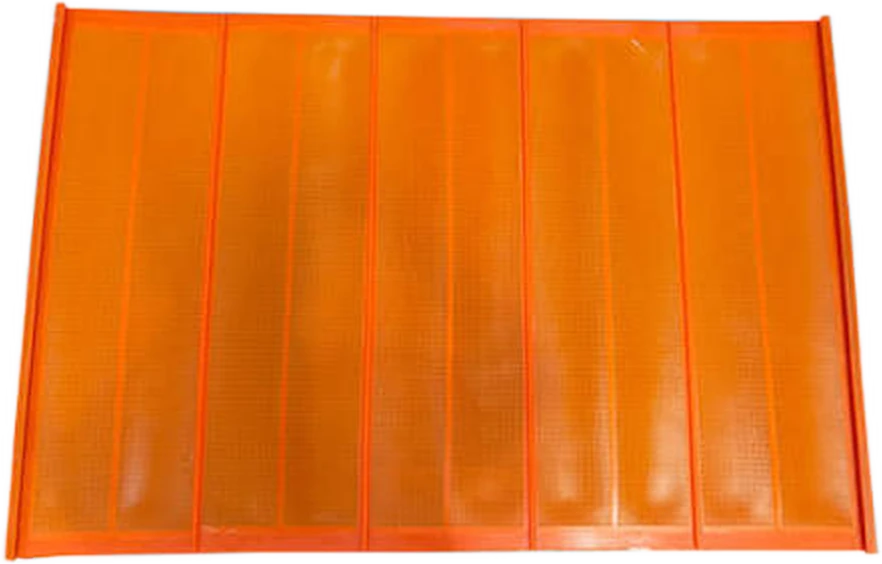
Example: mesh for a high-frequency screen.
Dewatering screens: sand dewatering screen
The sand leaving through a hydrocyclone underflow carries a lot of water. The dewatering screen, also called a sand dewatering screen or dewaterer, lets it fall onto a fine vibrating mesh: the water and fines pass through, and the sand keeps less moisture so it can be stockpiled and loaded.
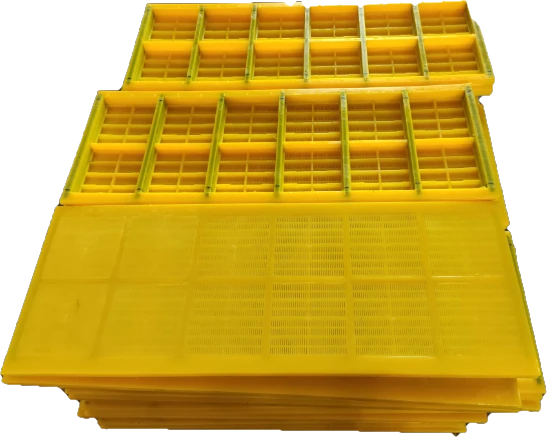
Where it fits in the plant
A typical layout: the material enters a screen that cuts it into two fractions; the fine fraction goes by pump to the hydrocyclone; the hydrocyclone overflow carries the fines away and the underflow goes to the dewatering screen, from which the final sand comes out. That is why the hydrocyclone, the pump and the dewatering screen should be sized together: if one fails, the others feel it.
What affects the final moisture
- Feed flow rate and percentage of solids
- Particle size: more fines means more water retained
- Mesh aperture and condition of the panels (blinded, worn)
- Inclination, frequency and amplitude of the vibrator
- Distribution of the feed across the width of the screen
We do not promise a specific moisture without knowing your product: it is estimated from the flow rate, the particle size and the installed equipment.
Fixings and fixing profiles
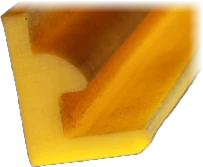
Profiles to fix the panels to the screen, in different sections: Knocking and Pass (L-type). Tell us the screen model and the length you need, or send us a photo or a sample.
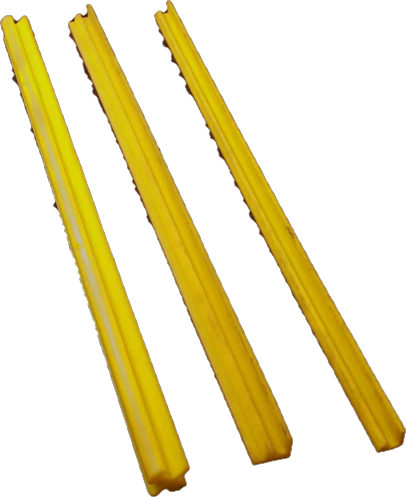
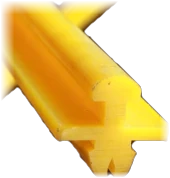
Custom meshes of all types
We supply custom meshes and panels for screens from different manufacturers, in the sizes and for the applications you need. In polyurethane, steel or rubber. The material, the mesh aperture and the fixing system are defined according to your screen.
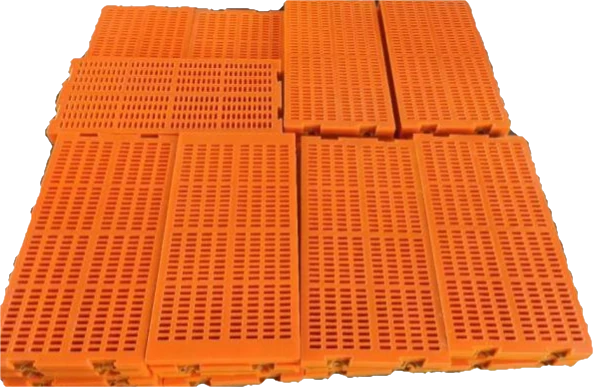
Custom meshes and panels, to suit your screen.
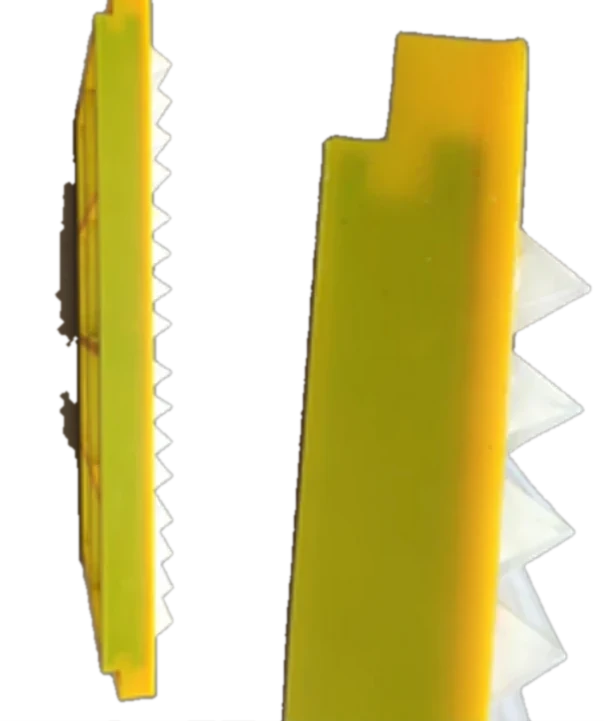
Pyramidal meshes
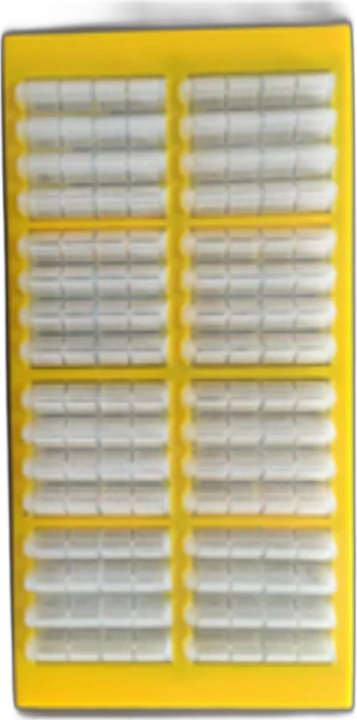
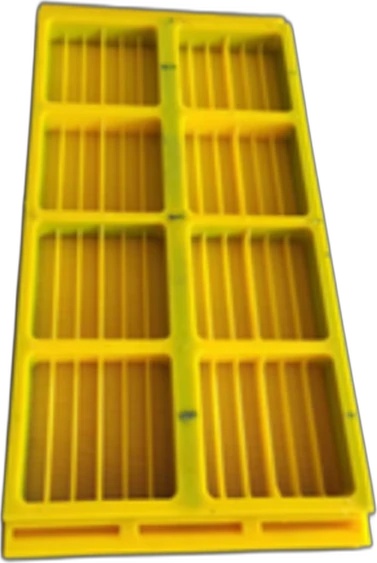
We also supply pyramidal meshes: modular panels with pyramid-shaped inserts. Tell us your screen model and the panel dimensions, or send us a photo.
Which material to choose: steel, polyurethane or rubber
| Steel (woven wire or perforated plate) | Polyurethane | Rubber | |
|---|---|---|---|
| When to choose it | Dry screening, coarse product, tight budget | Abrasive, wet material or with fines; good service life | Impacts and large rock falling, less noise |
| Abrasion | Medium | High | High |
| Wet, sticky product | Blinds easily | Better behaviour | Acceptable |
| Very small apertures | Yes | Depends on the panel manufacturer | Not recommended |
| Large rock impact | Fair | Good | Very good |
| Noise | High | Medium | Low |
| Things to bear in mind | Wears out sooner with abrasive material | Higher initial cost | Less precise with small apertures |
The table is indicative: the real result depends on the hardness of the panel, its thickness and the conditions of the plant.
What to decide when choosing a mesh
- Material: steel, polyurethane or rubber, according to abrasion, moisture and impact
- Mesh aperture: the opening that sets the cut size
- Open area: more openings give more capacity, but less strength
- Fixing system: the panel has to fit the existing frame (clipped, tensioned, bolted)
- Thickness and hardness: they set the service life and the behaviour with large rock
The mesh aperture and the type of panel determine the capacity and the quality of the cut. The aperture is usually chosen slightly above the cut size you are after, because in a real screen part of the material passes or is retained outside the ideal. If you do not know which mesh your screen has, send us a photo and the frame measurements: with that we identify the panel and its fixing system.
If you already have the screen and the cut is not what you expected, before changing the mesh it is worth looking at three things: the condition of the panels, the feed (flow rate and distribution across the width) and the movement of the vibrator.
Signs that the mesh needs replacing
- Product of a size that should not pass in fine screening
- Broken or enlarged openings, or panels that have come loose
- Less capacity than usual with the same feed
- Blinded panels that are no longer cleaned by the vibration
- Visible wear in the areas where the material falls
What data we need to quote
- Make and model of the screen or dewatering screen, number of decks and dimensions of each frame or panel
- Panel fixing type and current mesh aperture and the one you want to achieve
- Screened product, approximate moisture and flow rate in t/h; for dewatering screens, % solids and the final moisture you get today
- Photos of the mesh, the panels, the vibrator and the screen nameplate
Frequently asked questions
Do you supply custom meshes?
Yes, according to the dimensions of the frame or dewatering screen, mesh aperture and fixing type. For dewatering screens, normally in polyurethane.
Polyurethane or steel?
With abrasive or wet material, polyurethane usually lasts longer. For dry, coarse material, steel can be cheaper. It depends on the application.
Which mesh suits wet material?
Polyurethane panels tend to blind less than wire mesh on wet product; the final choice depends on the aperture and the flow rate. Tell us your case.
How often is a mesh replaced?
There is no fixed interval: it depends on the abrasiveness of the product and on the tonnage. It is replaced because of wear, not by date; we recommend checking it periodically.
Can I replace only the damaged panels?
Yes, as long as they use the same fixing system. We will tell you whether it is worth it or whether it is better to replace the full set.
What is a dewatering screen?
A vibrating screen with a fine mesh that separates the water from the sand to leave it with less moisture. It is also called a sand dewatering screen or dewaterer.
Is it the same as a screw classifier?
No. The screw classifier and the dewatering screen perform similar functions with different technologies; the best option depends on the plant. We can assess it on a visit.
Do you inspect screens and dewatering screens on site?
Yes, it is part of our technical advisory service: condition of panels, feed and vibrators.
Tell us what you need
Contact us and we will sort it out as soon as possible. Tel. 611 777 957 · comercial@asemining.com